To view on the Vegas Inc. website, please click here.
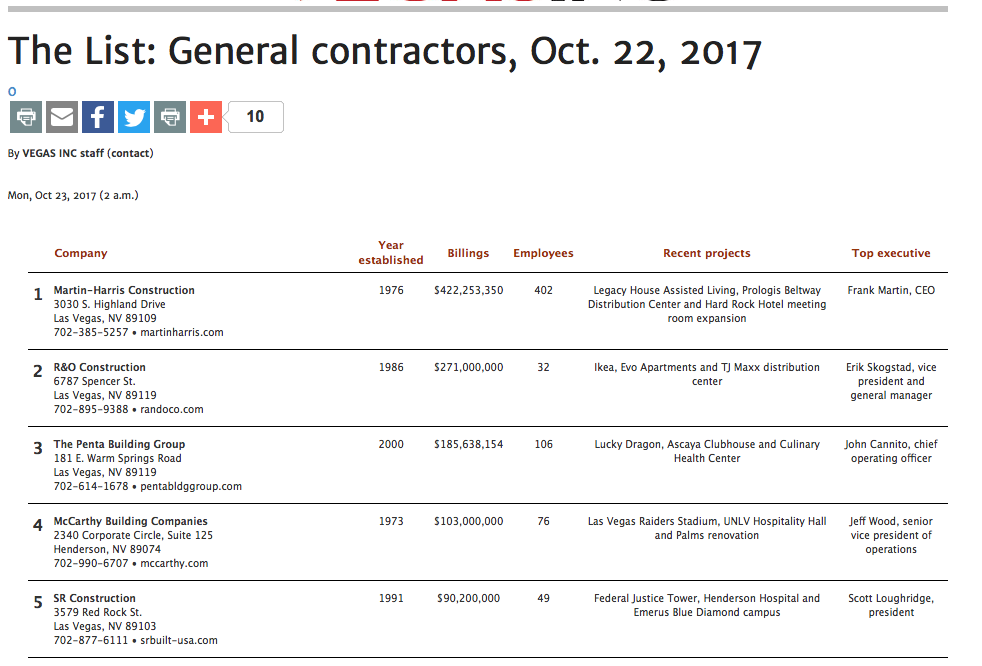
Bob Cunningham is the vice president of business development and marketing at SR Construction.
Hirschi Masonry was presented the Safe Partner Award from the Nevada Safety Consultation and Training Section.
—
To view on the Vegas Inc. website, please click here.
—
To view on the Henderson Chamber of Commerce website, please click here.


For the second installation of our Wall of Fame series, we’re highlighting Brett Hales, who comes from a long line of masonry professionals dating back to the early 1900’s. He’s been in the industry for over 20 years, starting out at around seven years old, and is currently the Vice President of Hirschi Masonry, in Las Vegas, Nevada.
—
To view on the MASONRY Magazine website, please click here.

Cory Whitlock – Las Vegas Firefighter/Paramedic
“It’s really encouraging to see a community rise to the occasion, whether it be our professional firefighters, the first responders—AMR, Mediquest, community ambulance, security, Metro—even the public. Everyone rose to the occasion. You have to look at the silver lining a little bit. Bonding our communities together so that we can be more successful, more powerful, as one—that’s what this is all about.”
—
To view on the Las Vegas Weekly website, please click here.
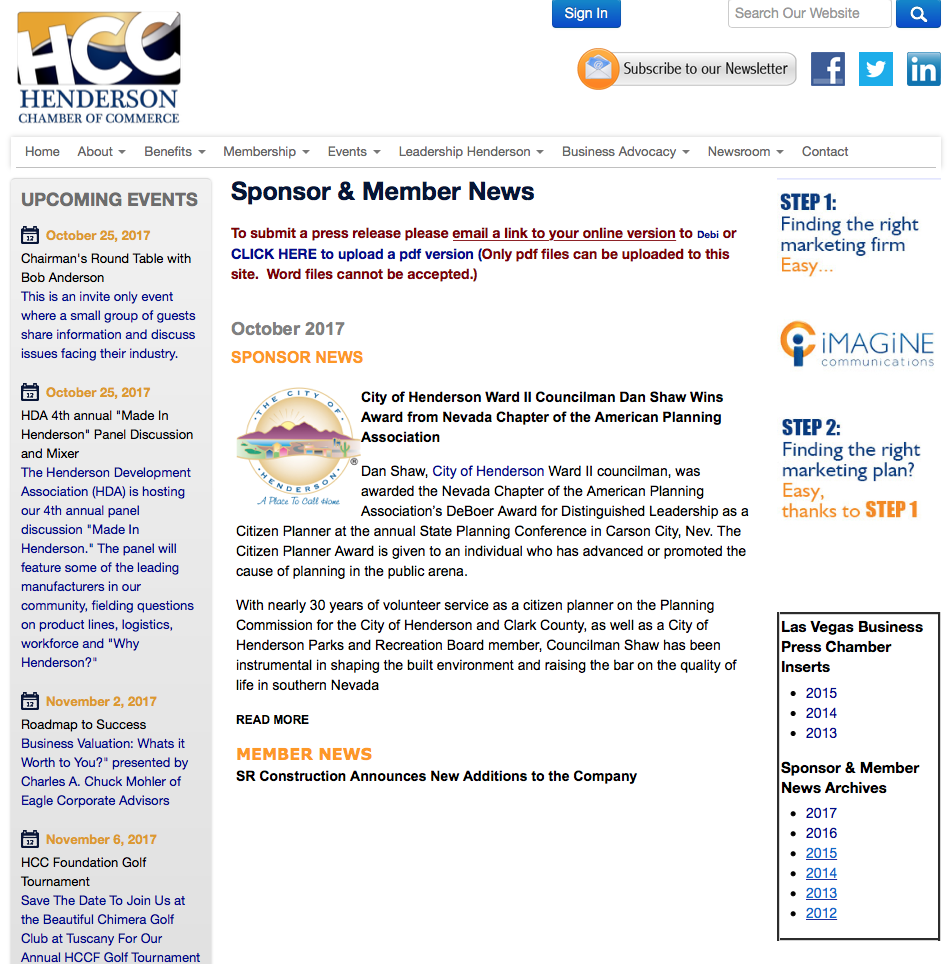
Dan Shaw, City of Henderson Ward II councilman, was awarded the Nevada Chapter of the American Planning Association’s DeBoer Award forDistinguished Leadership
as a Citizen Planner at the annual State Planning Conference in Carson City, Nev. The Citizen Planner Award is given to an individual who has advanced or promoted the cause of planning in the public arena.
With nearly 30 years of volunteer service as a citizen planner on the Planning Commission for the City of Henderson and Clark County, as well as a City of Henderson Parks and Recreation Board member, Councilman Shaw has been instrumental in shaping the built environment and raising the bar on the quality of life in southern Nevada.
In addition to his volunteer service, Councilman Shaw has directly impacted the development of the high quality of life for Henderson residents. During his tenure as chairman of the Henderson Planning Commission, Councilman Shaw worked to implement a new development code, increasing the standards to the City of Henderson. During his time with the county as chairman of the Clark County Planning Commission, he worked to facilitate increased planning coordination between local municipalities through adoption and early implementation of regional planning efforts such as the Southern Nevada Strong Regional Plan.
Councilman Shaw has greatly impacted the growth in southern Nevada during his 33-year Henderson residency. He has made various efforts to contribute his time and expertise to help steer the development in the city of Henderson. He was responsible for the construction of multi-family housing units, as well as shopping centers, office parks and industrial improvements.
The Nevada Chapter of the American Planning Association serves to promote public involvement and excellence in planning and to improve the quality of life in the State of Nevada through professional development and education.
—
To view on the Nevada Business Magazine website, please click here.

Ben Kole and his daughter Rachel, both EMTs, were at Sunday’s concert.
—
When Joe DiGaetano showed up for his 24-hour shift as a paramedic coordinator at 7 a.m. Sunday morning, he was ready for anything, but expected it to just be another Sunday.
After a typical weekend day of paperwork, answering calls, and making some deliveries, DiGaetano and his team were settling in for the night.
“Everybody winds down around 9 o’clock. We go into the room, we take our boots off,” he told ABC News in an exclusive interview. Several members of the team turned on HBO and started watching a movie.
But at 10:08 p.m., the call came in: Reports of a “mass casualty incident.”
“When my phone rings, for serious calls, it rings differently,” he said.
In less than 60 seconds, he grabbed his radio off the charger and was on his way to the spot where Jason Aldean had just left the stage amid a hail of gunfire.
DiGaetano is an EMS flip coordinator and has worked with Las Vegas Fire and Rescue for 20 years. The vehicle he drives into emergencies is stocked with various medical supplies, from bandages to medications that can “bring someone back to life after they’ve died from smoke inhalation,” he said. He is accustomed to walking into tragedies. He says he switches gears in high-pressure situations.
“You find ways to take emotion out of the emergency because when you show up, they want to make sure that they called the right guy who’s going to fix this, not a guy who’s going to be sad with them and be upset with them. They don’t need that, they’re already there.”
DiGaetano says by the time he arrived at 10:20 p.m., four command centers had already been set up, and he reported to the southern command post at Russell Road and Las Vegas Boulevard.
“When I arrived, the shooting had stopped. It was still I would say a scene of chaos. We didn’t know at any moment, any car driving toward us was that the bad guy getting away, was that a good guy or these people shot,” he said.
Amid the chaos, DiGaetano jumped in and immediately began triaging patients who had arrived at the center. He says when he arrived they immediately started filling the ambulances with the most critically wounded.
“We have a golden hour from the moment the trauma happens, the moment the surgeon gets to do his thing. There’s an hour there where you really have a good chance of keeping these people alive. After that, it really goes down by a significant amount. It’s like falling off a cliff.”
Triage levels were assigned based on criteria like breathing rate, amount of blood lost, pulse rate and consciousness. Decisions were made in moments using a color system.
“’Black’ means you’re deceased, ‘red’ means you’re very critical, ‘yellow’ is you can stay on scene for a minute, and ‘green’ means you’re walking wounded, you have, you know, a sprained ankle, a cut that’s manageable, nothing that’s gonna need an ambulance or a hospital now,” he said.
But making those determinations could be painful for both the paramedic and the patient. “You had to actually tell people with gunshot wounds, ‘You’re not as critical as this person. Wait a minute.’ To them it was the worst thing in their life, and we’re telling them to hold on.
“Within about 20 minutes, we had used up all of the ambulance resources that we had,” said DiGaetano. So he called his battalion chief and called for all the ambulances from Las Vegas County that were available. “I told him, hey, there’s a big event in the county, I’m going to drain your fleet of rescues.”
As the EMS flip coordinator, DiGaetano’s vehicle full of supplies was critical to help the dozens of people with injuries. Around 11 p.m., he was called to the eastern command center, which ran along the eastern fence line of the concert on Reno Avenue.
“We get there and that’s the area where people were coming out. They were jumping over the walls from the venue into the street and into a church across the street,” he said.
He also organized groups of paramedics and armed officers called “force protection teams.” He says people of all stripes, mostly self-reported off-duty servicemen and women, were stepping forward to help.
“Anybody who wanted to help, we would take you. Off-duty firefighters, off-duty cops, civilians from out of town who were off-duty firefighters, they made themselves known. I’m not going to lie, we believed them, we put them to work.
“The initial critical people were being organized and led by the off-duty firefighters and cops. They were actually turning over cattle gates, loading people up and picking up like stretchers and hand carrying them out.”
The force protection teams were dispatched into the concert area to search for more wounded people who had scattered in fear.
“You had people hiding in that church in a parking lot in their cars. You had people hiding in semi trucks, people hiding in the venue, under tables and behind walls and they stayed there for 20 or 30 minutes.”
At about midnight, DiGaetano says he reported to the northern command post, at Tropicana Boulevard and Reno Road, where he says his help was needed taking part in a force protection team himself.
“I was given my team of firefighter paramedics. I was also given a team of patrol and detective officers from Metro who were armored and with their AR-15s — heavy weaponry.”
The team immediately found two people, one with a gunshot to the leg, another with trampling injuries. He instructed his paramedics to administer oxygen and IVs, and they moved on.
After answering 911 calls to the MGM and Fat Burger, he was suddenly called away again.
It was about 1 a.m. and DiGaetano said, “We were given a new assignment by our commander who was told by SWAT that they have four teams they want to send into Mandalay, do a room-by-room search. They want to be able to have us [paramedics] there in case they go into a room and there’s another victim that’s not identifying themselves via radio or cell phone or any other means.”
He said the four teams were each given master keys and were instructed to sweep the entire hotel.
“We went from floor to floor, room by room and literally opened every door in the Mandalay Bay to make sure that entire hotel was safe.”
“Most of the rooms didn’t have anybody in it, but the rooms that did, they identified themselves prior to entering. They get in there. The citizens were very thankful that they got that room searched because everybody was obviously scared.”
He said the four teams took several hours searching every one of the rooms in the hotel, from about the 13th floor all the way up to the Foundation Room on the 62nd floor — skipping the 32nd floor, where Stephen Paddock, the alleged shooter, had shot concertgoers from his room. According to the Mandalay Bay website, there are 3,211 guest rooms in the hotel.
After several hours of canvassing each room of the Mandalay Bay hotel, the teams had completed their assignment by about 5 a.m., Monday morning.
“We got down and demobilized where the northern commander had basically said, ‘That was your last assignment…. You’re free to go.’ I spent that half-hour from 5:00 to 5:30 shaking hands and saying goodbye to the people I just met and/or people I’d worked with and giving hugs.”
As the sky began to lighten, DiGaetano stopped for a coffee on his way home, where he met another officer on her way into work.
“I stopped at Starbucks, and then I actually happen to meet a Metro CSI agent who was just getting on for the day. So I was getting off, she was getting on. I bought her a cup of coffee. We both got grande white mochas,” he said.
She told him “she was actually going to be one of the people who had to take photographs of the people who didn’t make it at the fairgrounds. That was her assignment. She wasn’t looking forward to her day but like all professionals, she was ready for it,” he said. “She went to work and I went home.”
DiGaetano said the night was, by far, the largest mass casualty incident of his career, and he hopes he never gets a call like that again. But he’s proud of his city’s response to the unthinkable tragedy.
“Vegas is an example of strangers stepping up when they weren’t asked to. And if you want an example of what the best of this country is, you should look at the response that Vegas gave. Whether you’re a firefighter, a police officer, a civilian who was enjoying a concert show, everybody did something.”
—
To view on the ABC News website, please click here.